
Power Brake Unit - Checking for vacuum loss (loaded), Checking for hydraulic pressure
P-27spec tableFluid pressure specs differ by engine (B6 DOHC vs K8 DOHC) and transmission (MTX vs ATX).
Loaded condition
Checking for vacuum loss (loaded condition)
- 1Start the engine.
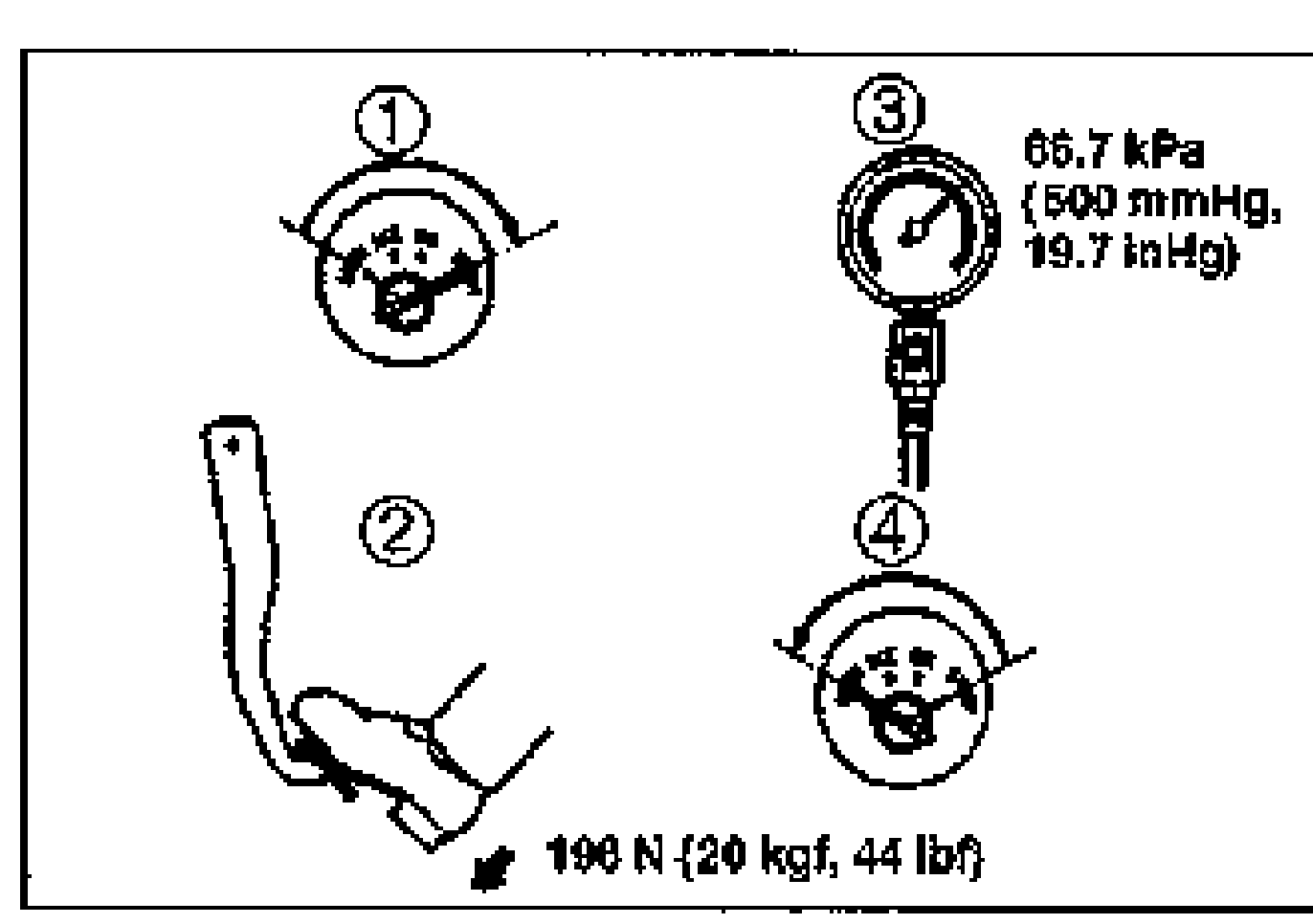
- 2Depress the brake pedal with a force of 196 N {20 kgf, 44 lbf}.
- 3With the brake pedal depressed, stop the engine when the vacuum gauge reading reaches 66.7 kPa {500 mmHg, 19.7 inHg}.
- 4Observe the vacuum gauge for 15 seconds. If the gauge shows 63.3—66.7 kPa {475—500 mmHg, 18.7—19.7 inHg}, the unit is operating.
b) Checking for hydraulic pressure
1. Depress the brake pedal with the engine stopped (Vacuum 0 kPa {0 mmHg, 0 inHg}). If the fluid pressure is within specification, the unit is operating.
Fluid pressure (engine stopped, vacuum 0)
196 N {20 kgf, 44 lbf}
Fluid pressureB6 DOHC .. 588 kPa {6 kgf/cm2, 86 psi} min
196 N {20 kgf, 44 lbf}
Fluid pressureK8 DOHC .. 393 kPa {4 kgf/cm2, 57 psi} min
2. Start the engine. Depress the brake pedal when the vacuum reaches 66.7 kPa {500 mmHg, 19.7 inHg}. If the fluid pressure is within specification, the unit is operating.
Fluid pressure (engine running, vacuum 66.7 kPa)
196 N {20 kgf, 44 lbf}
Fluid pressureB6 DOHC (MTX)...6081 kPa {62 kgf/cm2, 882 psi} min
196 N {20 kgf, 44 lbf}
Fluid pressureB6 DOHC (ATX)....6767 kPa {69 kgf/cm2, 982 psi} min
196 N {20 kgf, 44 lbf}
Fluid pressureK8 DOHC ....... 7061 kPa {72 kgf/cm2, 1024 psi} min